Showing posts with label CSP. Show all posts

Tuesday, July 15, 2008

Mediterranean Solar Plan gets green light


Sometimes certain decisions are determined in the international political arena that are seismic in their potential for shaping our future yet remain largely under the radar of general public knowledge. Of course CSP being my bag, means I am here to bring you the latest sunny developments - and the future is indeed looking bright.

In Paris on Sunday 13th July at the Heads of State Summit, a formal declaration launching the Union for the Mediterranean was issued, laying out the goals and workings of the 43-member organisation. One initiative in particular holds huge promise - the formal endorsement of the Mediterranean Solar Plan, which was presented by German Chancellor Angela Merkel. Even Gordon Brown has backed the Solar Plan, stating at the conference: "in the Mediterranean region, concentrated solar power offers the prospect of an abundant low carbon energy source. Indeed, just as Britain's North Sea could be the Gulf of the future for offshore wind, so those sunnier countries represented here could become a vital source of future global energy by harnessing the power of the sun. So I am delighted that that the EU is committing at this summit to work with its neighbours - including Egypt, Jordan, Morocco and the League of Arab States - to explore the development of a new 'Mediterranean Solar Plan' for the development and deployment of this vital technology from the Sahara northwards.".

According to the International Energy Agency in it's recently published Energy Technology Perspectives 2008 - Scenarios and Strategies to 2050, on top of the investments in the Business-as-usual scenario, total additional investment needs for the period 2010-2050 amount to USD 45 trillion. The average year-by-year investments between 2010 and 2050 needed to achieve a virtual decarbonisation of the power sector include, say the IEA, the build of 215 million square metres of solar. Others technologies proposed to achieve 50% cuts by 2050 include 55 fossil-fuelled power plants with CCS, 32 nuclear plants and 17 500 large wind turbines as well as widespread adoption of near-zero emission buildings and, on one set of assumptions, deployment of nearly a billion electric or hydrogen fuel cell vehicles.

The Union for the Mediterranean agreed that the recent activity on energy markets in terms of both supply and demand, confirms the need to focus on alternative energy sources. Market deployment as well as research and development of all alternative sources of energy was declared a major priority in efforts towards assuring sustainable development. The Secretariat is now tasked to explore the feasibility, development and creation of a Mediterranean Solar Plan. It is expected that 20GW of CSP will be constructed by 2020, with electricity exports transmitted into Europe, and exponential growth thereafter.

The political will is now in place for the deployment of CSP plants in the Sahara Desert, with transmission of it's clean electricity into Europe. It's nemesis will of course be nuclear. But CSP has many advantages over nuclear: rapid construction times (3 years versus 10 -20 years), low environmental impact (even positive environmental impact can be achieved where desalination is incorporated in the plant, thereby providing water for both human consumption and agricultural use), unlimited availability of resource (in any given 2 week period, deserts receive the same amount of energy from the sun as is contained in all nuclear fuel reserves), lower security and terrorist risk (compare the bombing of a nuclear plant to the taking out of a bunch of mirrors in the desert - transnational devastation versus 7 years bad luck). Let the race commence.

Thursday, January 10, 2008

No to Nuclear, Yes to CSP


With John Hutton set to announce a new generation of nuclear power stations for the UK today, it raises the issue of what price such a benefit would be.

Whilst it cannot be denied that our current generation would benefit from nuclear energy generation, it will be future generations who will carry the detriment of the legacy that remains.

Future generations will carry the burden of policing it, paying for it as well as suffering the consequences if /when disaster strikes, which would result in substantial additional economic, environmental and social costs.

Whilst we were not fully aware of the potential future consequences back in the 1950's, or were reckless in proceeding without understanding those consequences and detriment to others, we now carry the knowledge of the inherent risks and costs to future generations. With that knowledge comes the responsibility to ensure the highest possible standards of safety and damage limitation strategies are imposed. Likewise, with it comes the duty to implement a programme of cessation of current use of nuclear as soon as possible.

The only conclusion I can draw, is this: to proceed with a new generation of nuclear would be morally wrong, especially where other solutions, including Concentrating Solar Power, are viable, cost competitive, renewable, low carbon and benign.

Greenpeace response:
Greenpeace Nuclear Power Briefing
Energy Bill:
Energy Bill, Bill 53 07-08

Earlier Postings:
Why I say No to Nuclear
Concentrating Solar Power - the DESERTEC vision
Concentrating Solar Power Basks in the Glow of a Sunny Future

Friday, September 07, 2007

Concentrating Solar Power


Latest short (3 mins) video on Concentrating Solar Power - the remarkable global solution to our energy needs.

Sunday, January 28, 2007

Energy Revolution Report: How to cut Global Energy CO2 Emissions by 2050

Just how on earth is this planet going to substantially reduce it’s carbon emissions? For sure, it will require radical solutions to be implemented, and a groundbreaking study released this week provides the very roadmap we so desperately need. The report is the first comprehensive analysis of how the global energy system can be restructured based on a detailed assessment for the potential of proven renewable energy sources, energy efficiency and the utilisation of efficient, decentralised cogeneration. Such a route would deliver nearly 70% of global electricity supply and 65% of global heat supply by 2050.

The report, ‘Energy [R]evolution: A Sustainable World Energy Outlook', was developed in conjunction with specialists from the Institute of Technical Thermodynamics at the German Aerospace Centre (DLR) and more than 30 scientists and engineers from universities, institutes and the renewable energy industry around the world. Commissioned by the European Renewable Energy Council (EREC) and Greenpeace International, it demonstrates how we can halve global CO2 emissions by 2050, whilst allowing for increased energy consumption and economic growth. It concludes that renewable energies must represent the backbone of the world’s economy – and that includes developing countries such as China, India and Brazil.

Structural change is at the core of the report. Decentralised technologies and energy systems connected to local distribution networks and large scale renewable energy supplies, such as large offshore wind farms and Concentrating Solar Power plants will be key components. This will achieve higher fuel efficiencies and reduce distribution losses.

In stark contrast, following a "business as usual" scenario would see demand for energy double by 2050, the authors warn.


The report also highlights the short time window for making the key decisions in energy infrastructure. Within the next few years governments, investment institutions and utility companies have to act. Within the next decade, many of the existing power plants in the OECD countries will come to the end of their technical lifetime and will need to be replaced, whilst developing countries such as China, India and Brazil are rapidly building up new energy infrastructure to service their growing economies.

This is a rallying call for governments to phase-out subsidies for fossil and nuclear fuels by 2010 and introduce the `polluter-pays principle`. The market as it currently exists is distorted by the fact that it is still virtually free for fossil and nuclear fuel industry to pollute. Current conventional energy subsidies (to the tune of $250-300 billion worldwide) artificially reduce the price of power, keep renewable energy out of the market place and prop up non-competitive technologies and fuels. Thus, at present new renewable energy generators have to compete with old nuclear and fossil fuelled power stations which produce electricity at marginal costs.

Without political support renewable energy remains at a disadvantage, marginalised by the distortions in the world’s electricity markets created by decades of massive financial, political and structural support to conventional technologies. Developing renewables will therefore require strong political and economic efforts, especially through laws that guarantee stable ‘feed-in’ tariffs over a period of up to 20 years.

Energy Revolution presents demands that are needed in the energy sector to encourage a shift to renewable sources. The main ones are:
• Phase out all subsidies for fossil and nuclear energy and internalise external costs of damage to health and the environment
• Establish legally binding targets for implementation of renewable energy
• Provide defined and stable returns for investors
• Guarantee priority access to the grid for renewable power generators
• Implement strict efficiency standards for all energy consuming appliances, buildings and vehicles

This a report with far reaching aims which, it is hoped, will result in far reaching consequences – consequences that would contribute to sustainable economic growth, high quality jobs, technology development, global competitiveness and industrial and research leadership. And of course, a whopping 50% reduction in carbon emissions. All we need do now is start working out how to tackle the remaining 30%

Energy [R]evolution: A Sustainable World Energy Outlook

Tuesday, November 28, 2006

Concentrating Solar Power: how mirrors can light up the world


Yesterday the Guardian published an article on my favourite energy solution. It's called Concentrating Solar Power (CSP).

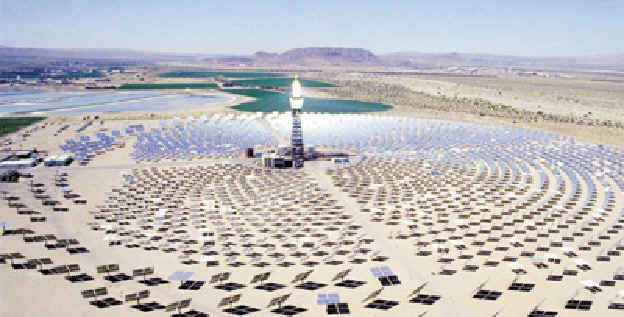
It's a simple, potentially wide ranging and hugely effective solution to our energy needs - not just for the UK, but for the whole of Europe and beyond. Just three vital components are needed - lots of sunshine, lots of space and lots of mirrors, which are arranged so that they focus the sunlight into a small area.

This is how it works: the sun hits the mirrors, which then concentrate the sunlight to create heat. Ever done that ladies survival trick of using a compact-mirror to light a fire? Well, it's a similar principle, except rather than lighting twigs the heat created can be used to generate electricity by raising steam and driving a Stirling turbine, just like a conventional power station.

The electricity can then be transmitted via very efficient high-voltage direct-current cables (‘HVDC’) throughout Europe, the Middle East, North Africa. Some of these HVDC transmission lines are in place already but more would be needed in the proposed new system. The heat from a CSP plant can be stored so that electricity generation may continue through the night and on cloudy days.

There are numerous advantages to this solution:
1. CSP works. There are CSP plants operating successfully in California, Arizona, Spain, the Nevada desert and Southern Australia.
2. It's a carbon-free, nuclear-free solution
3. CSP has huge potential in terms of scale. Every year it pours down the equivalent of 1.5m barrels of oil of energy for every square kilometre.
4. A Europe-wide grid of HVDC Transmission lines could be stored underground and even under the sea.
5. Although capital costs would be high, running costs and maintenance would be low. After all, no uranium or fuel needs to be found - it is merely dependent on the sun as it's constantly renewable source of energy.
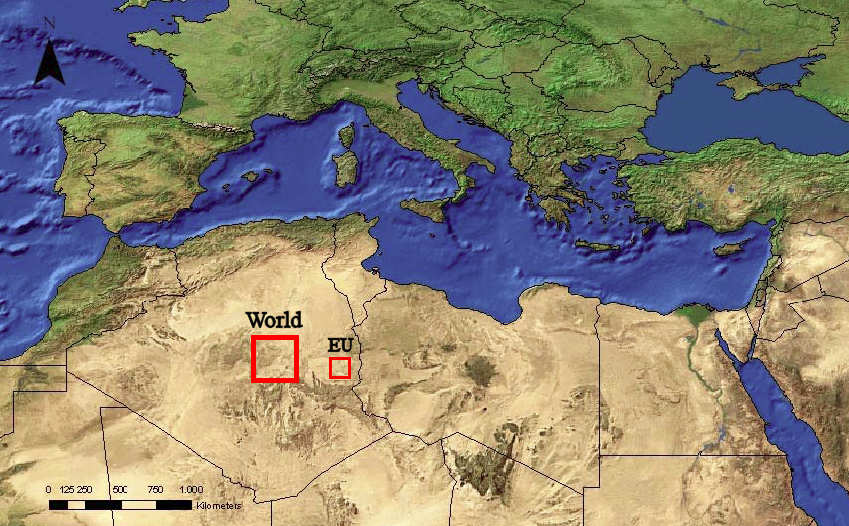
6. Studies by the German Aerospace Centre demonstrate that by covering just 0.5% of the world's hot deserts with CSP would provide the world's entire electricity needs, with the technology also providing desalinated water to desert regions as a valuable byproduct, as well as air conditioning for nearby cities.

7. CSP is cheaper than oil (currently at $60 per barrel and increasing), calculated at around $50 per barrel of oil equivalent for the cost of building a plant, falling sharply to about $20, as the production of the mirrors reaches industrial levels. It is about half the equivalent cost of using the photovoltaic cells that people have on their roofs. The TRANS-CSP Report estimates that CSP electricity delivered to London would cost about 5.5 eurocents per kilowatt-hour, including the cost of transmission.
8. The electricity generated can be transmitted over very long distances with transmission losses of no more than about 3% per 1000 km. For the whole of Europe, the Middle East and North Africa, it is estimated that average transmission losses would be about 10%. Considering that the ‘fuel’ is free, this compares well with the 70%+ losses that have been accepted for many years in conventional coal-fired power stations (where the fuel is far from being free).
9. Unlike nuclear with it's storage problems, unresolved sequestration issues, high cost of obtaining uranium and high risk of terrorist intervention, CSP has none of these disadvantages.
10. It's a brilliant solution.

The German scientist Dr Gerhard Knies states "Contrary to what is commonly supposed it is entirely feasible, and cost-effective, to transmit solar electricity over long distances. Solar electricity imported to Europe would be amongst the cheapest source of electricity and that includes transporting it," he says. "CSP imports would be much less vulnerable to interruption than are current imports of gas, oil and uranium." It's a realistic solution, and it's a solution we could implement now.

  • For further information, go to the comprehensive Trans-Mediterranean Renewable Energy Cooperation (TREC-UK) website

  • pdf of Guardian article

  • Go to www.trecers.net/news.html for interview with Dr. Gerhard Knies at "BBC The World Tonight"
  •